

AI Identity Governance & Runtime Assurance
Govern every AI agent. Verify every action.
Your AI agents already hold real access to real systems. WonderAgent makes each one a first-class enterprise identity — with an owner, an approved purpose, the access it actually holds, and a record of what it actually did.
Read-only to start. Your IAM stays the system of record.
The problem
AI agents got production access. Nobody gave them an identity.
An agent is provisioned like a service account, inherits access like a person, and acts continuously like neither. Your IAM records the credential. Nothing records the intent, the owner, or the behaviour — so the questions an auditor asks have no owner inside the business.
Who owns this agent?
It was provisioned as SVC_FINANCEBOT_PRD by someone who has since changed teams. No business owner, no technical owner, nobody to approve a change to its access.
What is it allowed to do?
Its purpose lives in a ticket, a design doc, or somebody's memory — never anywhere a control can evaluate it. So “is this access appropriate?” has no answer.
What did it actually do last night?
Runtime logs sit in an observability tool keyed by service name, disconnected from the identity, the entitlement and the approval that allowed it.
The gap is not that agents are dangerous. It is that nothing compares what an agent was approved to do against what it can reach and what it actually did — so excessive access is only discovered after it has been used.
The solution
Close the gap by holding all three answers at once.
WonderAgent keeps an agent’s approved purpose, its effective access and its observed behaviour side by side, and treats any divergence between them as a finding with evidence attached.
What is it approved to do?
From the agent's contract: its owner, approved applications, approved data and approved actions.
Financial reporting data · READ, REPORT
What can it technically do?
Effective access computed from your IAM — entitlements, roles, groups, scopes and tool permissions.
SAP · Snowflake/Finance · Snowflake/CustomerDB
What did it actually do?
Observed runtime behaviour, event by event, correlated back to the identity that performed it.
READ Snowflake/CustomerDB · 03:14 UTC
CAN exceeds SHOULD, and DID confirms the gap was used.
FinanceBot is approved for financial reporting data only, but holds an entitlement to Snowflake/CustomerDB — and the runtime log shows it read from there. Evidence is attached to the finding, not inferred after the fact.
Recommended
Revoke CustomerDB entitlement
Applied only after a human confirms, and the finding is re-evaluated once the access actually changes.
How the evaluation runs
One pipeline, running continuously.
Contract, entitlements and runtime events flow into the same deterministic comparison. No model decides whether access is appropriate — the rules do, and the evidence is kept.
Continuous comparison
Deterministic. Re-run on every access or behaviour change.
Excessive access, with evidence
Recorded with evidence, applied only on human approval.
Inside the product
Built for the person who has to answer for it.
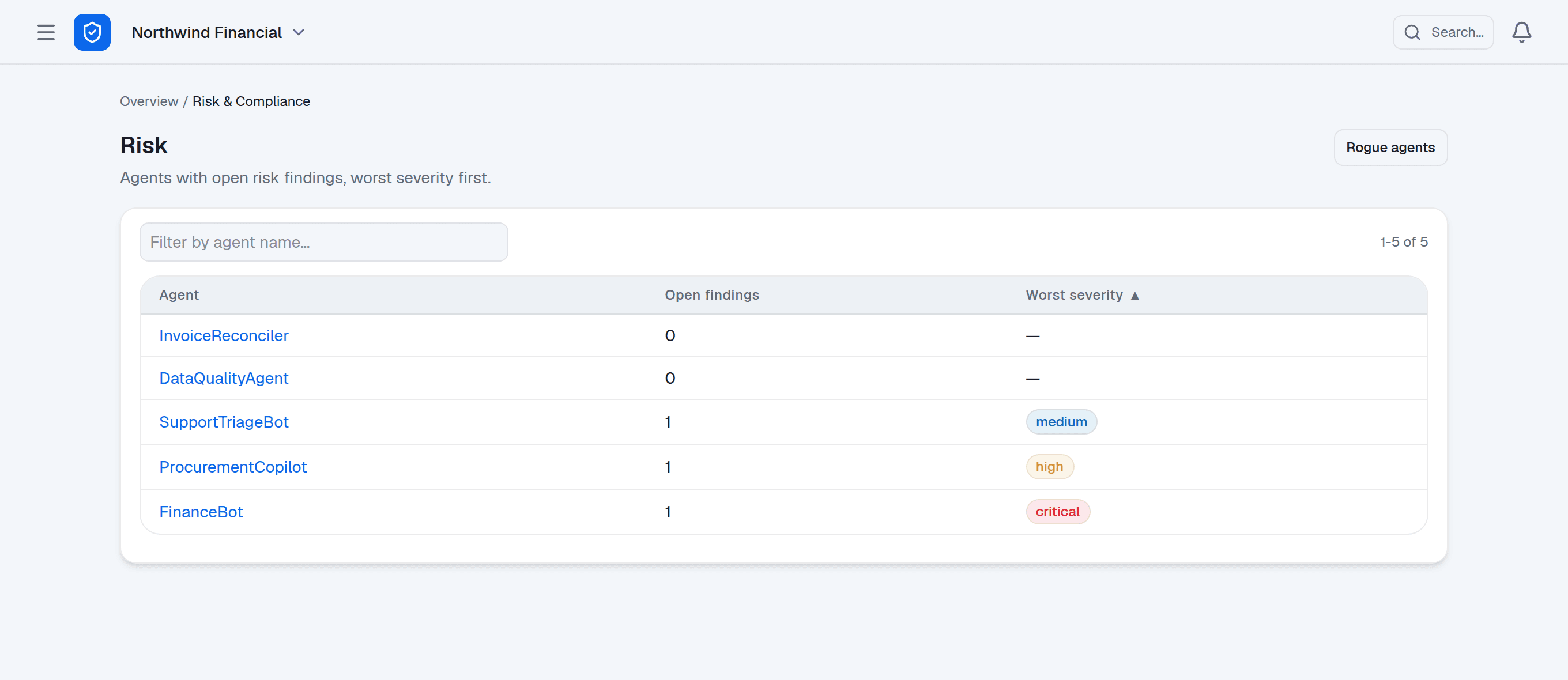
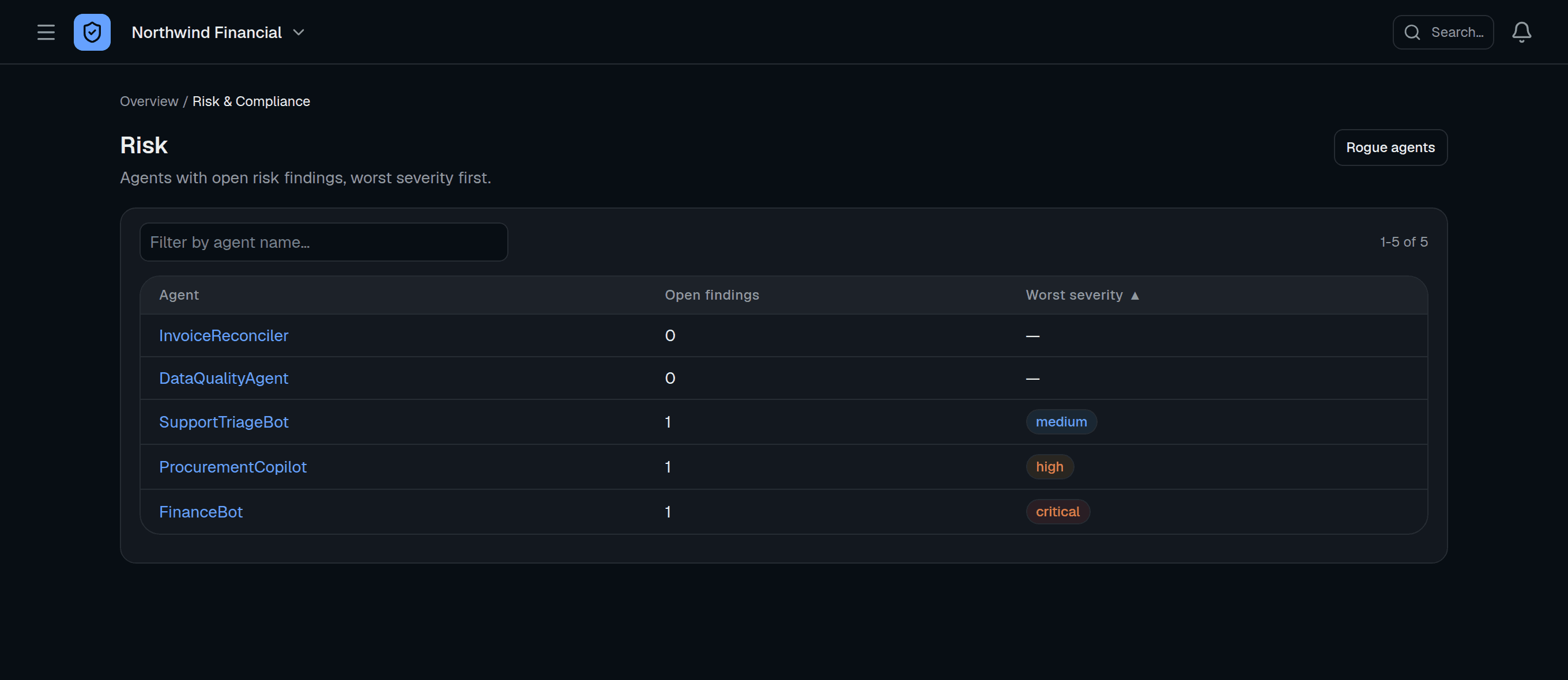
Risk, ordered by what to do first
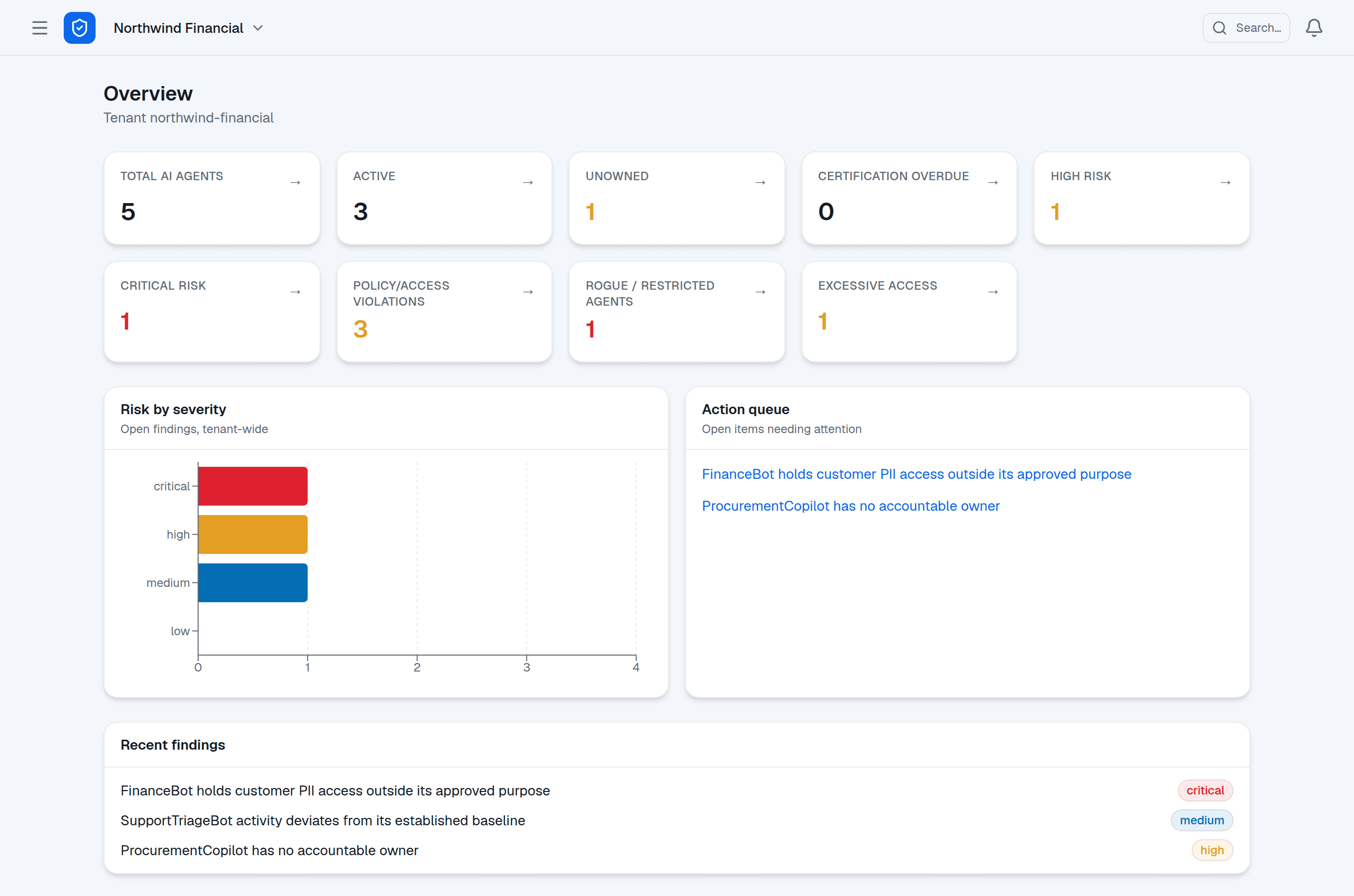
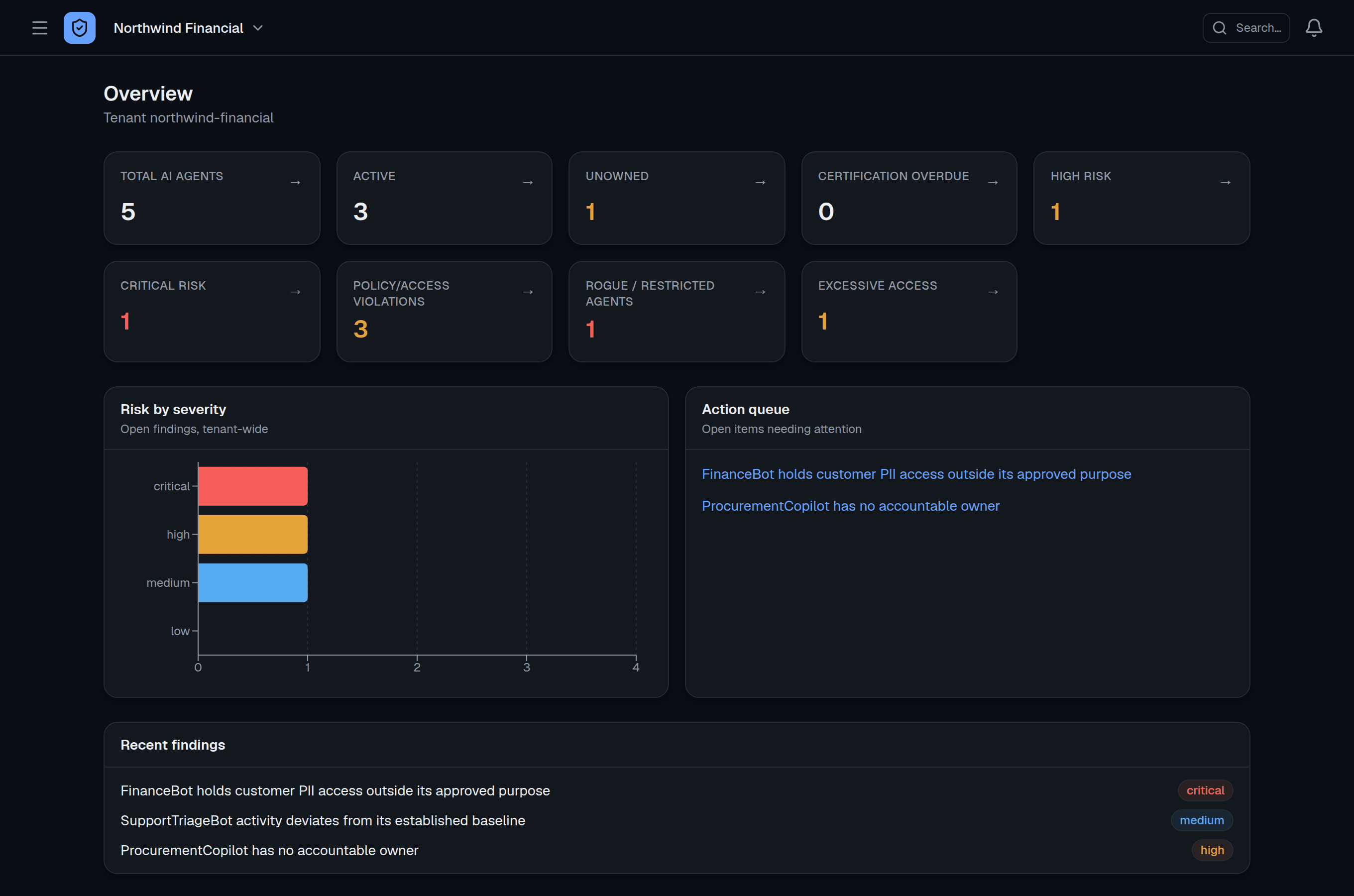
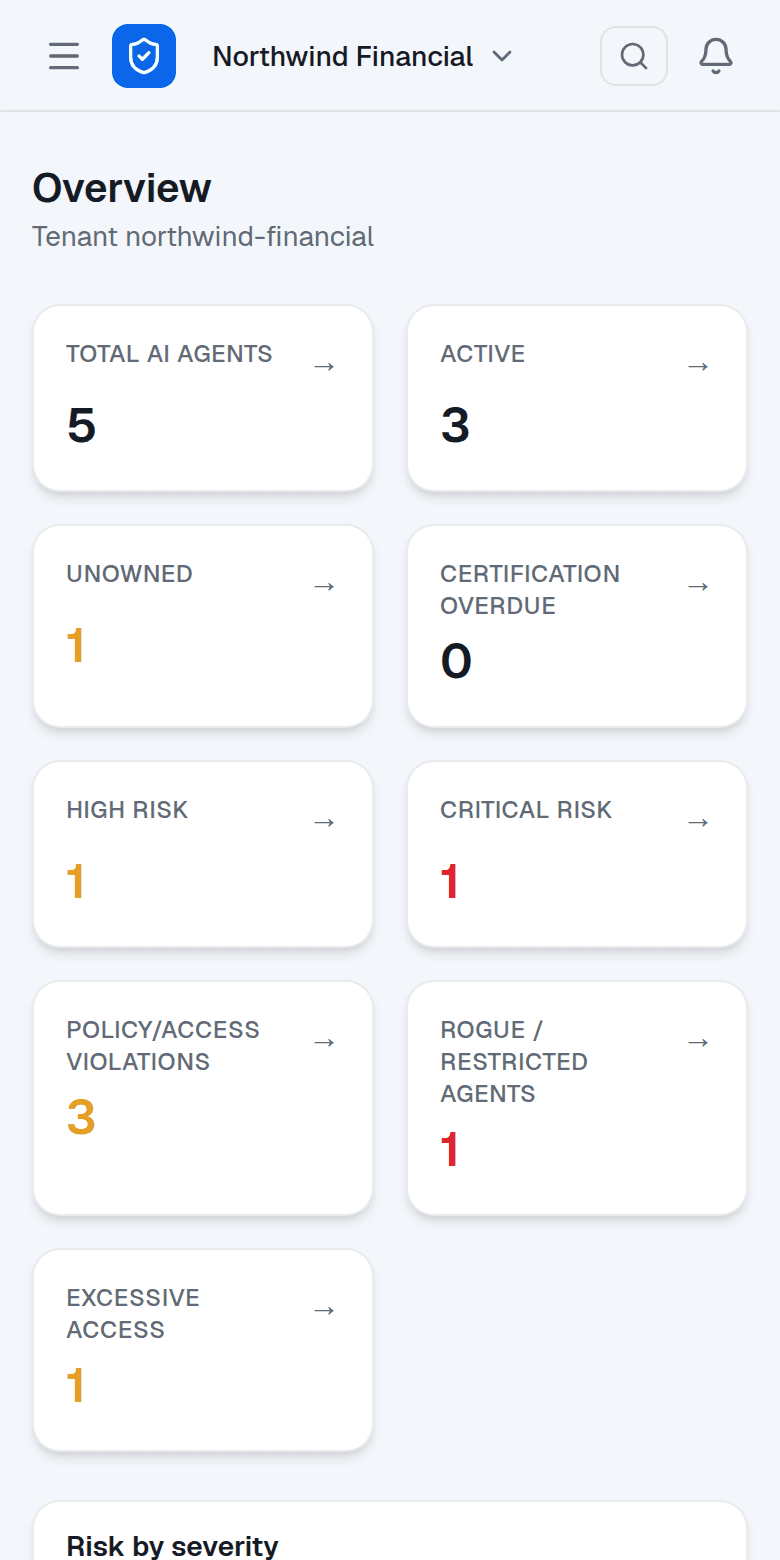
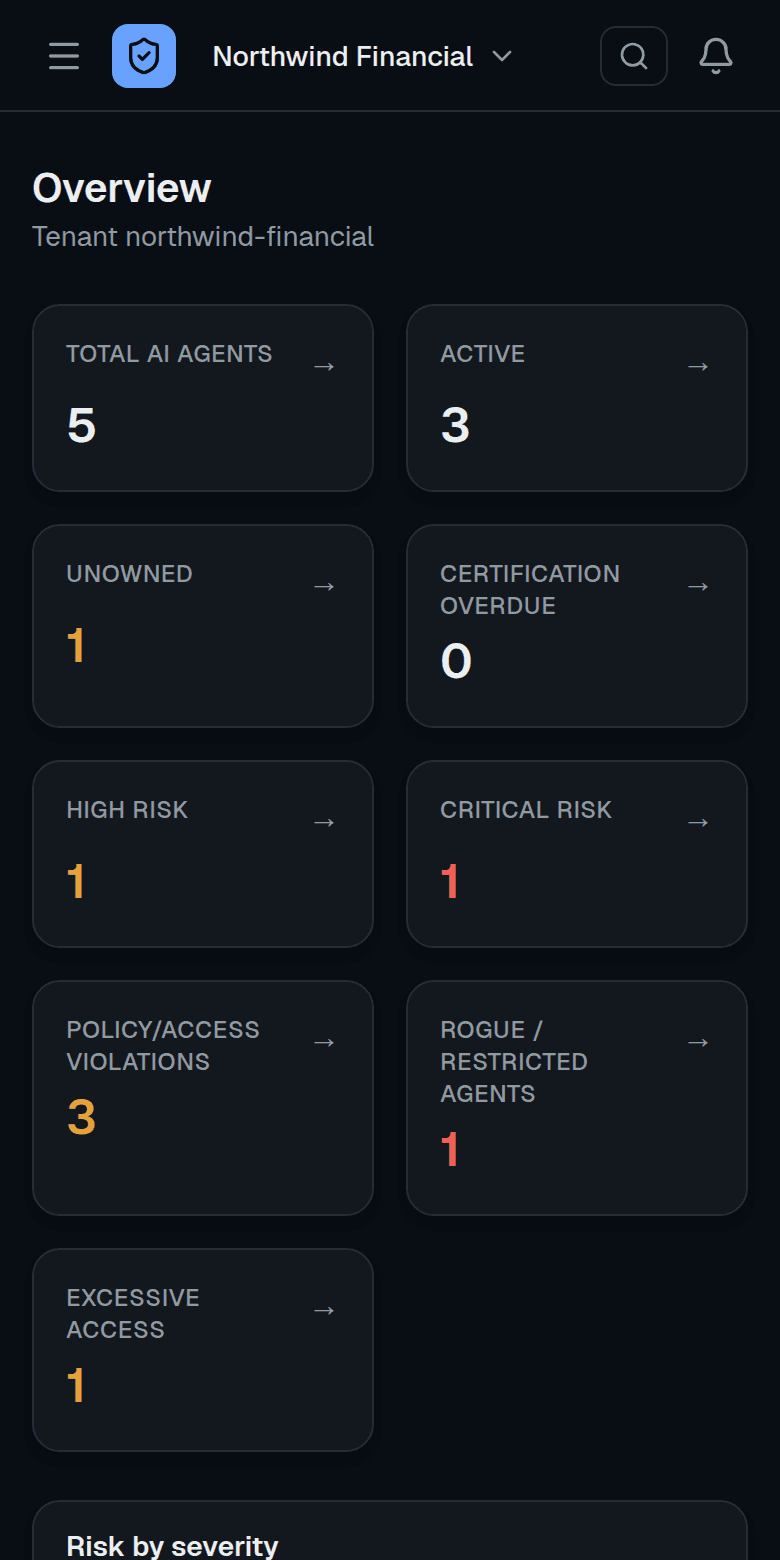
Every agent with an open finding, worst severity first, each one tracing back to the entitlement and the runtime event that produced it.
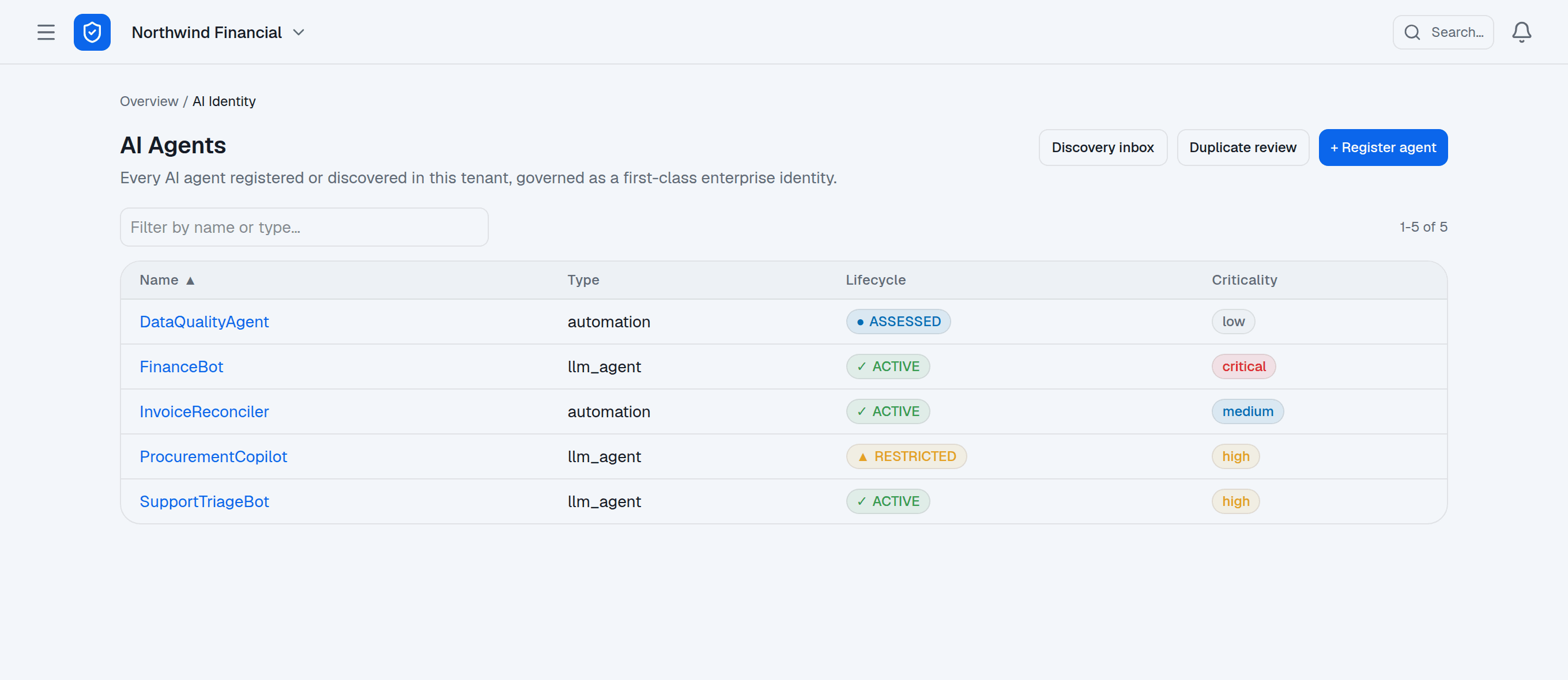
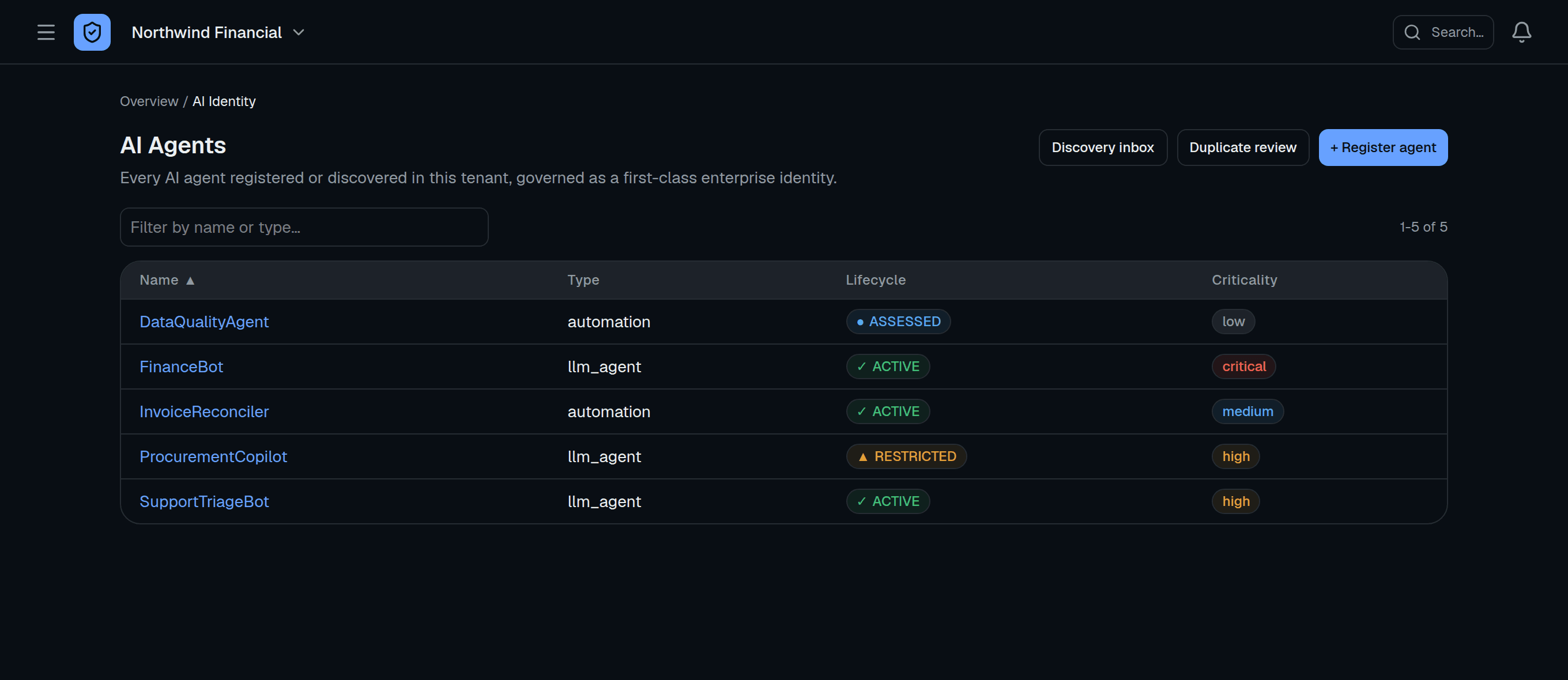
An inventory that is actually governed
Lifecycle state, criticality and accountable owner on every agent — so an unowned agent in production is a visible exception, not a silent one.
The platform
Identity governance built for non-human identities.
Not a replacement IAM, IGA, PAM or SIEM. A governance and assurance layer that sits over the ones you already run.
Agent identity & lifecycle
Every agent gets an owner, a purpose and a lifecycle state — from discovered through retired — instead of living as an untracked service account.
Effective access (CAN)
Resolve what an agent can technically reach today by walking real entitlements, roles, groups, OAuth scopes and tool permissions from your IAM.
Runtime assurance (DID)
Observe what the agent actually did — every tool call, resource and action — and compare it against what it was approved to do.
Risk & rogue detection
Deterministic scoring across excessive access, unauthorized resources, sensitive-data violations and behavioural deviation. Never an LLM guess.
Certification & evidence
Run access certification campaigns over agents, with a reproducible evidence snapshot behind every decision a reviewer makes.
Works with your IAM
Vendor-neutral by design. Saviynt, Okta, Entra, custom IAM and MCP runtimes map into one canonical model — your IAM stays the system of record.
How it works
From unknown agents to certified ones.
- 01
Connect what you already run
Import agent identities and their access from your existing IAM, plus runtime events from your MCP or REST sources. Read-only until you say otherwise.
- 02
Declare the agent's purpose
Name an owner, the approved applications, the approved data and the approved actions. That contract becomes SHOULD.
- 03
Watch the three diverge
WonderAgent continuously compares approved purpose, effective access and observed behaviour, and raises an evidence-backed finding the moment they stop agreeing.
- 04
Remediate through your workflow
Every recommended revocation waits for a human to confirm it, is recorded against the finding as evidence, and is re-evaluated once the access changes.
Know what every agent should do, can do, and did.
Create your organization and register your first agent in minutes.